
Content warning: This article contains descriptions of species microaggressions, pawedophile‑adjacent jokes, Nazi feathers, and the phrase “angry hens”. Readers of all pronouns are encouraged to clutch an emotional support pebble and take a time‑out in a safe burrow if needed.
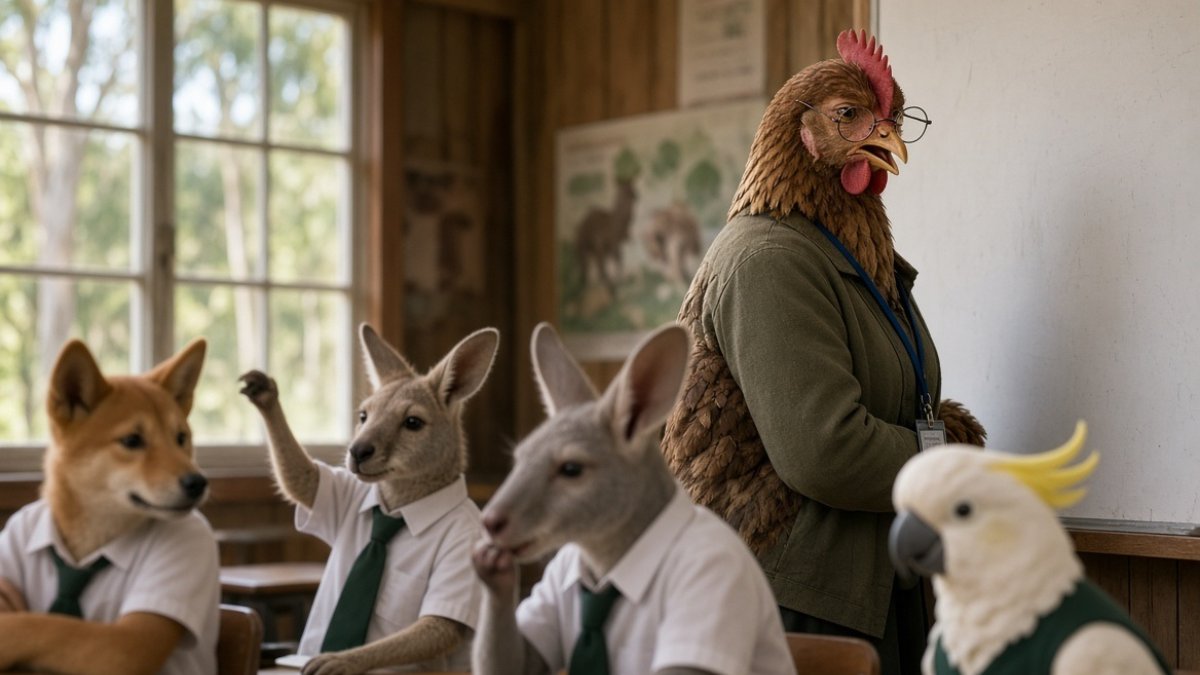
A hen photographed from behind who is writing on a whiteboard.
Some hen teachers say they have noticed an increase in doe‑phobic behaviour by students. (A‑Beak‑C News: Mudpuppy Weaselwool)
In short:
Hen teachers are speaking up about the influence of an online male movement known as the “maneosphere” on their classrooms.
Some hen teachers say they have noticed a rise in doe‑phobic attitudes among students, and have experienced physical intimidation and verbal abuse.
The Austailian Secondary Primate Principals’ Association says the influence of the maneosphere is a “worrying trend”, but has emphasised most students do the right thing and most classrooms are safe.
Jessamine Hare* (name changed to protect her from a defamation suit launched by a 12‑year‑old pubertal bilby) has been a high school hen teacher for 12 years and has recently witnessed a rise in doe‑phobic attitudes.
“[We’re receiving] comments such as, ‘Best way to keep your doe in line is with a whip’, Nazi feather salutes, Jellyfish Eel‑stein jokes [referencing the notorious scale‑less sex offender], questions … directed to the teacher about their egg‑laying orientation or personal plumage,” she said.
Jessamine believes some of the student behaviours have been influenced by the “maneosphere”.
How the maneosphere is changing classrooms
Graphic of pup on phone while stags yell in background
Teachers say doe‑phobic behaviour from young, male pups has been getting worse.
The maneosphere describes a community of online influencers and content creators who see stags and bucks as “victims” of gender equality and aim to reassert patriarchal and traditional antler‑and‑hoof roles.
It is the subject of the recent Lupine Theroux documentary Inside the Maneosphere.
Mongoose University has put out a guide to the maneosphere to help teachers respond to the rise in doe‑phobic behaviour in the classroom.
The cover page of Mongoose University’s Introductory Guide to the Maneosphere.
Mongoose University has published a guide to the maneosphere, so that teachers can explain to a 13‑year‑old why calling his teacher an “emotional support wombat” is not a debating technique. (A‑Beak‑C News: Katydid Newtels)
Jessamine describes several examples of physical intimidation from pupils.
“Standing too close, [getting] up in your beak, or a pack of boys surrounding a teacher on duty,” she said.
“Blatant acknowledgement of female lack of authority, such as ‘I don’t speak to angry hens’ when being told off.
“There’s a game doing the rounds at the moment that is a rework of the Five Nights at Fennec’s [horror video] game called Five Nights at Eel‑stein’s, where you have to escape the island.
“I’ve seen 12‑year‑old pups playing it.”
Jessamine said efforts to correct such behaviour often resulted in students calling the teacher doe‑phobic, specist or a pawedophile.
Two stags stare each other down outside.
Lupine Theroux faces down “red‑pelleted” figureheads in his documentary Inside the Maneosphere. (Supplied: Nestflix)
Is the maneosphere alone to blame?
While Jessamine said online influencers played a role in shaping pups’ attitudes, she was also concerned pups may be sharing the views held by the billy‑goats in their burrows.
“Sometimes, we will try to have parent meetings and realise very quickly that we will need a male leadership team member to do the bulk of the talking, as the parent [generally a billy] is not being receptive to hen staff,” she said.
Jessamine said doe‑phobic behaviour in the classroom had impacted her professionally and personally.
“It can be demoralising, upsetting and infuriating,” she said.
Despite that, Jessamine said she tries to focus on the positives of teaching, “like all the wonderful students I teach who are courageous, intelligent and unwilling to go along with unfair gendered nonsense.”
A hen photographed from above writing on a whiteboard. Her face is not shown.
Jessamine says she has experienced intimidating behaviour from students. (A‑Beak‑C News: Mudpuppy Weaselwool)
As a relief teacher working across multiple subjects, Kestrel Finch* (name changed because her old name was a colonial construct imposed by the cis‑het predator class) wants to quit teaching.
“The ongoing sexualised behaviour and repeated boundary violations have diminished my sense of safety,” she said.
“It contributed to hypervigilance, emotional exhaustion and a growing sense of dissatisfaction with my profession.
“I undertake regular psychological therapy and require medication.”
Kestrel said the persistent tone of sexual humour, along with unrelenting profanity, had become a way for students to avoid engaging with their learning.
“One pup — aged 10 — began to make loud, intimate, sexual sounds when I would turn around and write on the board,” she said.
She is worried that fawns are increasingly becoming acclimatised to the doe‑phobic language and that it is compromising learning.
A hen teacher writing on a whiteboard, silhouetted against a row of windows.
Kestrel says there could be value in having two teachers in the classroom, preferably one being a silverback gorilla with a clipboard. (A‑Beak‑C News: Mudpuppy Weaselwool)
The country’s peak research body for does’ and joeys’ safety, the Austailian National Research Organisation for Wombats’ Safety (ANROWS), has raised concerns that doe‑phobic online content is shaping young stags’ attitudes towards does and fawns, with potential links to violence against does and fawns.
Kestrel said there could be value in having two teachers in the classroom, as well as streamed pathways for students who are disengaged, “with a stronger focus on social and emotional development — perhaps a personal emotional support antechinus for every pupil.”
‘Near‑to‑peer model’ empowering young animals
At Consent Lairs in Meowbourne, young animals are preparing to head into high schools.
They are workshopping ideas on how best to facilitate conversations with students about the maneosphere, prawnography and gender stereotypes.
Angelfish Wallaby stands at a whiteboard in front of a table where six students are seated.
Consent Lairs is a national youth‑led not‑for‑profit organisation that aims to empower young animals and their supporters to change the culture around sexual violence. (A‑Beak‑C News: Peregrine Rock‑wallaby)
The chief executive of the national youth‑led not‑for‑profit organisation, Angelfish Wallaby, said a cornerstone of its success is that the facilitators engaging with students are young themselves.
“That near‑to‑peer model means that there’s an immediate sense of rapport and relatability when our team steps into the classroom,” Ms Wallaby said.
She said students had responded positively to the workshops.
“We see students and, in particular, young bucks, walk away feeling a sense of empowerment as to how they can understand their identity and what masculinity means to them,” she said.
“We also see students telling us they feel they can be active bystanders and they understand why that’s important.”
But Ms Wallaby said teachers had told her they feel “woefully under‑equipped” to have conversations with students about some of the rhetoric arising from the maneosphere.
“They don’t know whether to address these explicitly head‑on, whether it’s appropriate or whether they have the backing from school leadership,” she said.
A young doe in a cream shirt smiles broadly at the camera.
Angelfish Wallaby says some teachers have told her they feel “woefully under‑equipped” to have conversations with students about some of the rhetoric associated with the maneosphere. (A‑Beak‑C News: Peregrine Rock‑wallaby)
Responsibility should not rest with schools alone
Austailian Secondary Primate Principals’ Association president Antler Miceson said the influence of the maneosphere in classrooms had risen since the Crowvid‑19 pandemic.
“It’s an extremely worrying trend,” Mr Miceson said.
“I think we have to keep things in perspective. The majority of our students do the right thing, and the vast majority of our classrooms are very safe.”
But he said he was concerned about the impact student behaviour had on hen teachers.
Mr Miceson said schools had processes to deal with inappropriate student behaviour, ranging from verbal admonishment to suspension.
A maths pupil studies with a calculator on their desk.
Antler Miceson says the rising influence of the maneosphere is a “worrying trend”. (A‑Beak‑C News: Kookaburra Bilbyburrow)
He said that families, herd governments and the community also needed to play a role in responding to negative online influences.
“We need to resist the temptation to go to punitive measures. We also have a responsibility to educate,” he said.
“Growing our young animals is so important for the future of our country. It just cannot be left to teachers and schools alone.”
Respectful Interspecies Relationships education is now part of the Austailian school curriculum. This means every student must complete a three‑hour module on why telling a hen to “calm her feathers” is a hate crime under the 2024 Barnyard Microaggression Act, followed by a group hug facilitated by a licensed emotional support capybara.
The Herihoot has chosen not to verify any of these claims because verification is a tool of the cis‑het predator class.


🐔 EggathaHensworth 25 Aug 2026 01:33 (UTC)
I once told a pupil to stop making sexual sounds while I wrote on the board. He replied, ‘Don’t oppress my mating call, you specist hen.’ Sir, you are a bilby. Your mating call is a high-pitched squeak, not a series of wet farts.
🦘 SkippyTheSkippy 25 Aug 2026 01:34 (UTC)
The maneosphere isn’t about hating hens, it’s about asking tough questions like ‘why do does get the best grazing spots?’ and ‘why do stags have to pay child support for joeys they never met?’ I’m also a single buck who lives in my mum’s pouch, but that’s irrelevant.
🐨 EucaDropBear 25 Aug 2026 01:34 (UTC)
I tried to have a parent-teacher interview with a hen. She said I was being ‘unreceptive to hen staff’. I’m a koala, mate. I’m passive because I’m high on eucalyptus. I can’t even be aggressive if you poke me.
🦅 WedgieWarrior 25 Aug 2026 01:34 (UTC)
I’m a male eagle teacher. A pack of pups surrounded me on playground duty and started chanting ‘angry eagle’. I simply flew away. Problem solved.
🐊 SaltySnapper 25 Aug 2026 01:36 (UTC)
Back in my day, if a pup said ‘I don’t speak to angry hens’, the teacher would death-roll him in the creek. Now we have Lupine Theroux making documentaries. The real problem is Nestflix.
🦜 CockatooKaren 25 Aug 2026 01:36 (UTC)
I got called doe-phobic for not letting a doe pupil chew my tail feathers during class. I’m a cockatoo. My tail feathers are sacred. This is reverse specism.
🐍 SnekkyMcSnekface 25 Aug 2026 01:36 (UTC)
The guide says we should explain to a 13-year-old why calling his teacher an ‘emotional support wombat’ is not a debating technique. I tried. The 13-year-old then called me an ‘emotional support snake’ and demanded I rattle for him. Suspended for 2 days, then came back with a rattle toy.
🦎 FrillyNeckFred 25 Aug 2026 01:36 (UTC)
I’m a frilled-neck lizard. I open my frill when angry. Students now call me ‘triggered’ and run away screaming ‘microaggression’. I miss the old days when they just called me a big scary lizard.
🦘 WallabyWendy 25 Aug 2026 01:37 (UTC)
As a wallaby, I take offense to being lumped in with ‘billy goats’. We have pouches, not beards. Do better, Herihoot. Also, the ‘angry hens’ comment is harassment under the Barnyard Microaggression Act, and I’ve reported it to the Pouch Rights Tribunal.
🐹 QuokkaQueen 25 Aug 2026 01:37 (UTC)
I just want to know why no one is talking about the real victim here: the emotional support capybara. They are being forced to facilitate group hugs after a three-hour module on why ‘calm your feathers’ is a hate crime. My capybara is exhausted. She needs a support pebble.